
The problem SIMORGH wants to solve
After a building collapses, the first challenge is obvious: reaching the people trapped inside. Modern rescue operations have access to extraordinary technology: smartphones, cellular networks, drones, cameras, thermal sensors and increasingly capable robots. Yet a collapsed building is an exceptionally hostile environment for all of them. Concrete, steel, debris and irregular underground spaces create barriers that are difficult for both people and radio signals to cross.
A victim may have a perfectly functional smartphone only a few metres away from a rescue team and still be unable to communicate with them. At the same time, rescuers need information from inside the structure: where people may be located, which areas are accessible, whether conditions are changing, and where it is safe to continue searching.
Traditionally, the problem in telecommunications is covering a large distance. But in this scenarios, the problem is crossing a very difficult one.
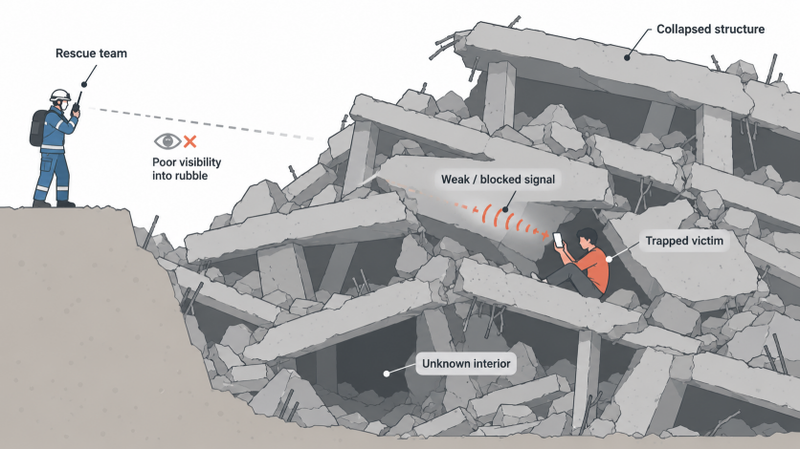
Traditional communication infrastructure is designed around relatively predictable environments. Rescue robots, meanwhile, are often sophisticated machines that must individually navigate through debris, maintain communication and carry useful sensors. This can make each robot comparatively large, complex and valuable; exactly the characteristics that become problematic when entering spaces where machines may become trapped, damaged or simply unable to pass.
This leads us to the problem we want to explore with SIMORGH:
How can we quickly extend sensing and communication into places that are dangerous, obstructed and inaccessible?
Our starting point is that perhaps we should not try to make one robot capable of doing everything. Perhaps the useful system emerges from many very small things working together.